
Why crocodiles spin while eating
Crocodiles and alligators look like perfect predators, but even they have their limitations. Their teeth are great for grabbing prey, but they are not very good at cutting meat into pieces. That is why one of the most impressive feeding techniques in nature has emerged: twisting the body while capturing prey, often referred to as the death roll.
This technique helps crocodiles tear large prey into pieces that are suitable for swallowing. It seems simple and crude, but behind it lies precise physics and sophisticated biomechanics.
The problem with large prey
Crocodiles are ambush predators. They wait in the water for a long time and then suddenly grab their prey. Small animals, such as fish or turtles, can be swallowed whole. Large prey is more difficult. A large animal cannot be swallowed quickly, and a crocodile is unable to bite off a piece of its body with its teeth.
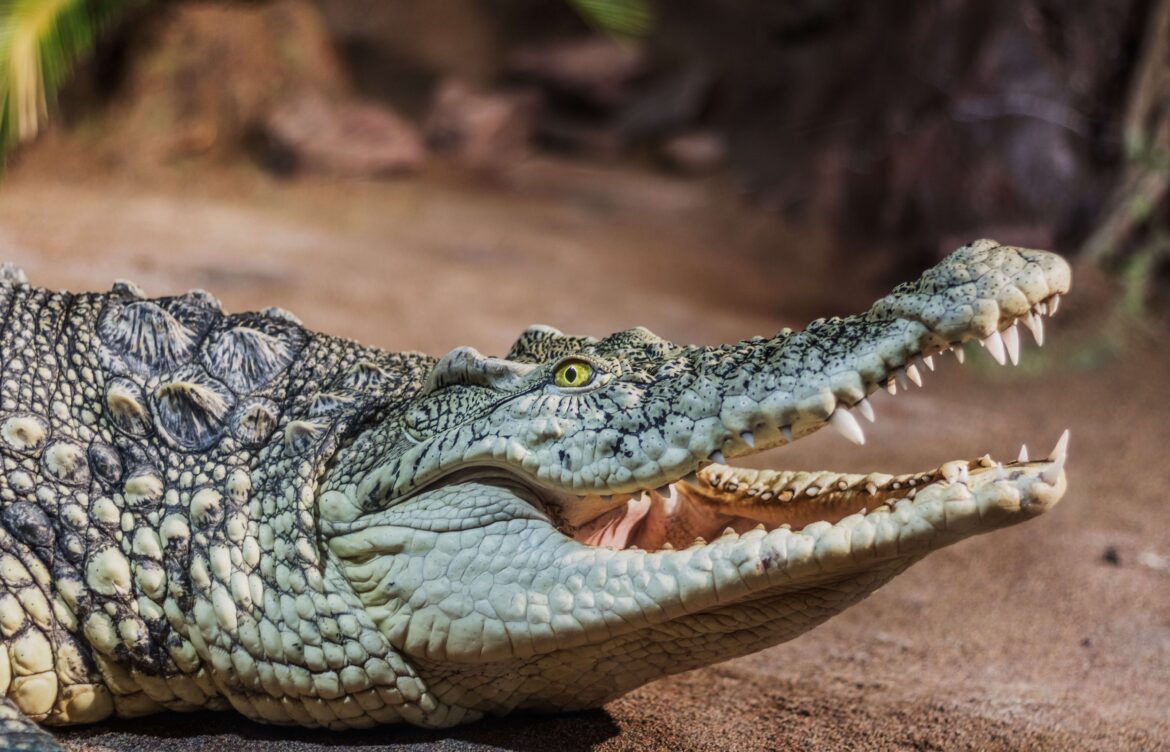
The shape of the teeth plays a key role. They are conical and smooth, which helps to hold prey, but is of little help in cutting through tissue. In such a situation, the crocodile needs another way to tear its prey apart.
How body rotation works
When a crocodile catches prey of the right size, it begins to rotate around its axis. This movement takes place in the water and looks like a quick and sharp turn of the whole body. The rotation creates a twisting force that tears the prey’s tissue.
The process looks like this:
- The crocodile firmly grasps its prey with its jaws
- It presses its paws against its body
- The tail swings sharply to the side
- The body begins to rotate rapidly
It is important to note that the paws are almost not involved in this movement. They are pressed against the body to reduce water resistance and increase rotation speed.
The role of the tail and the physics of movement
Studies have shown that the tail plays a key role. It is the tail that initiates the rotation. When the tail shifts from the central axis of the body, the distribution of mass changes. This creates a moment that causes the body to spin.
This principle is well known in physics. Figure skaters use a similar technique by pressing their arms against their bodies to accelerate their rotation. Crocodiles use the same mechanism instinctively and very effectively.
Scientists studied this process using high-speed cameras and found that even young individuals rotate with great force. As body size increases, the twisting force increases rapidly. A small crocodile exerts little force, while an adult is capable of developing enough force to tear the tissue of a large mammal.
Why twisting is so effective
The secret to its effectiveness lies in the properties of tissue. Muscles and tendons withstand stretching well, but resist twisting poorly. When a crocodile pulls its prey, the victim’s body moves with it. When it twists, the mass of the prey creates resistance and the tissue tears.
This technique allows the crocodile to use the victim’s own weight against it. A small animal easily rotates with the predator, while a large one resists and quickly loses its integrity.
From an evolutionary perspective, this is an example of a simple yet ingenious adaptation. Crocodiles have compensated for the limitations of their jaw structure by combining strength, physics, and precise control of movement.